

What the 2027 DSCSA Small-Dispenser Deadline Means for Your Unit Dose Labeling

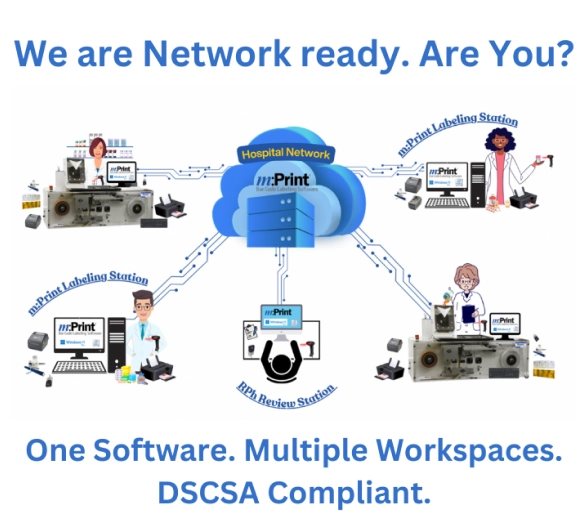
If your pharmacy is a small dispenser, you were working toward November 27, 2026 for the Drug Supply Chain Security Act (DSCSA) enhanced drug distribution security requirements. That date has moved. This guide explains what changed, who it applies to, what it does not change, and what your unit dose labeling has to be ready to do before the new date arrives.
What changed on August 14, 2026
On August 14, 2026, the FDA extended the small-dispenser exemption from the DSCSA enhanced drug distribution security requirements to November 27, 2027. The previous date was November 27, 2026.
In practical terms, small dispensers have one more year before those enhanced requirements apply to them. The FDA explains the exemption and its conditions on its page Exemptions under the Drug Supply Chain Security Act. Read it in full and check it against your own situation; this article is a plain-language summary, not legal advice.
An extra year is useful, but it is not a reason to stop. Most of the work a pharmacy has to do to be ready is operational: how product data gets from the stock bottle onto the unit dose label, how that data is checked, and how the record of each packaging run is kept. That work takes time to plan, buy, train and test, and the new date will come around quickly.
Who counts as a small dispenser
A small dispenser is one whose owning company has 25 or fewer full-time licensed pharmacists and qualified pharmacy technicians as of November 27, 2026, counted across the whole company.
Two parts of that definition matter more than people expect. First, the count is taken on a fixed date, November 27, 2026. Second, it is counted across the whole company, not per site. If your pharmacy is one of several locations under the same owner, you count the licensed pharmacists and qualified pharmacy technicians at every location together. A single site with a small team can still fall outside the exemption if the owning company is larger.
What the exemption does and does not cover
The exemption gives small dispensers more time on the enhanced drug distribution security requirements. It does not remove the product identifier, serialization or verification requirements that apply when you receive product.
That distinction is the one most likely to cause problems. Product still arrives at your pharmacy carrying a DSCSA 2D barcode with the product identifier on it. The obligations attached to receiving that product are still there. The extension changes the timing of the enhanced requirements; it does not change the fact that serialized data is already on your shelves.
For a pharmacy that repackages into unit doses, this means the data on the manufacturer container matters every day, not only after November 27, 2027. Whatever you put on your own unit dose label should trace back to the package it came from.
What DSCSA-ready unit dose labeling has to do
Whether you package on a tabletop packager or by hand, DSCSA-ready unit dose labeling comes down to four jobs:
- Read the 2D barcode on the stock container. The data should be captured by scanning, not retyped from the bottle.
- Carry the NDC, lot and expiry onto the unit dose label. The label on each dose should match the serialized package it came from.
- Calculate beyond-use dates. The beyond-use date has to follow your pharmacy's rules every time, not depend on who is running the batch.
- Keep a packaging log. You need a record of each run: what was packaged, from which lot, when, and by whom.
Each of these is a point where manual entry creates risk. A digit keyed wrong in a lot number, or a beyond-use date worked out differently by two technicians, is exactly the kind of error that is hard to spot on the label and hard to trace afterwards.
How m:Print® v4 with 1-Click Print® handles each of those
m:Print® v4 Bar Code Labeling Software was built around these jobs.
- Reading the barcode. m:Print® v4 scans, parses, inputs and reads the data in the DSCSA barcode on the stock container.
- Carrying the data to the label. With 1-Click Print®, the software automatically inputs the NDC, GTIN, manufacturer lot number, manufacturer expiration date and the unique manufacturer bottle serial number, then recalls the last label template used for that drug or your pharmacy's default template. In most cases there is no keyboarding at all. m:Print® can also print a DSCSA barcode containing a unique serial number on every package.
- Calculating beyond-use dates. The software automatically calculates the beyond-use date based on rules your pharmacy specifies, including USP Chapter 1178 and 1146 and the New York 50% Rule.
- Keeping the record. Automatic job numbering gives every packaging run full traceability without a manual log, and custom reports let you pull that history when you need it.
On the iPack® Rx tabletop unit dose packager, the same workflow runs end to end: an in-line bar code verifier scans and reads the barcode on every package, and a Pill Drop Sensor “sees” every tablet or capsule and prevents missed or empty packages. For a deeper look at the barcode itself, download our DSCSA barcode whitepaper.
Software and equipment support your process; they do not replace it. Your policies, training and oversight still determine how well the process works.
A 14-month plan: audit, software, training, go-live
From now to November 27, 2027 is roughly 14 months. A simple plan breaks it into four stages:
- Audit. Do the small-dispenser count for your owning company. Then walk through your current packaging and labeling process step by step and note every point where data is typed by hand, every place a beyond-use date is worked out manually, and how each run is recorded today.
- Software. Decide what has to change. Look for labeling software that reads the 2D barcode on the stock container, carries NDC, lot and expiry onto the label, calculates beyond-use dates to your rules and keeps a run history. If you package across several sites, check whether templates and data can be shared between them.
- Training. Give technicians and pharmacists time to learn the new workflow before it matters. Write down the steps, set up your label templates and beyond-use date rules, and run test batches.
- Go-live. Switch over well before the date, not on it. Leave yourself months, not weeks, to fix problems found in real use, and review your packaging records after the first few weeks.