

Unit Dose Packaging in Hospital Pharmacy: What to Look for in a Tabletop Packager

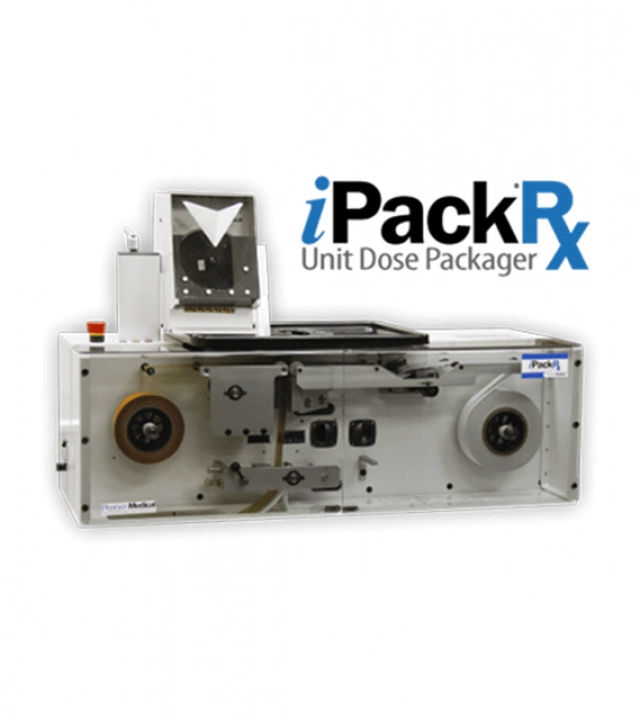
Buying a tabletop unit dose packager is a decision your pharmacy will live with for years. The brochure numbers rarely tell you what matters on a busy shift: how much bench it takes, how long a changeover lasts, whether fragile tablets survive, who types the label data, and who answers the phone when something stops. This guide walks through the questions worth asking before you choose a hospital pharmacy pre-packer.
Why hospital pharmacies pre-pack in-house
Most hospital pharmacies that pre-pack in-house do it for three reasons.
Cost per dose. Buying medication in bulk and packaging it yourself can lower the cost of each unit dose compared with buying every product already packaged in unit dose form. The savings depend on your volume, your formulary and your labor, so run the numbers on your own data.
Control. When you package in-house, you decide the label template, the barcode, the beyond-use date rules and the package size. You are not limited to what a supplier offers.
Shortages. When a product is not available in unit dose form, a pharmacy that can package its own doses has another option.
Bench space: what "tabletop" has to mean
"Tabletop" should mean the packager sits on a standard pharmacy bench and needs no dedicated room or floor space. Ask for the footprint and check it against the bench you actually have, including space for the computer, the labeling software and somewhere to stage bulk bottles and finished doses.
Ask too whether the printer is built in. A packager with an integrated direct thermal printer, with no ribbon to change, takes up less room and has one less consumable to manage.
Canisters or canister-free
Many automated feeders rely on drug-specific canisters, each calibrated for one medication. That model has costs: buying each canister, calibrating it, storing it, and the change-over time every time you switch drugs. When your formulary changes, the canister library has to change with it.
Canister-free feeders take a different approach. Questions to ask:
- Does the feeder need a canister for each drug, or can it handle most tablets and capsules without one?
- How long does a change-over from one drug to the next take?
- What happens when a new drug is added to the formulary?
Pearson Medical Technologies is the only company offering two non-canister automated feeder options. The intelliCount® Automated Universal Feeder uses patented self-calibrating vacuum technology and is designed to accommodate more than 95% of tablets and capsules. The Fillin Station™ Automated Feeder uses a non-mechanical flood-fill system; the user only needs to select the correct pill disk to begin packaging.
Crush protection for fragile tablets
Some tablets are soft, scored or brittle. A packager that crushes or chips them wastes medication and creates doses that cannot be dispensed. Ask:
- How does the packager protect fragile tablets as they drop and seal?
- Can you test-run your own most fragile products before you buy?
On the iPack® Rx, No Crush Technology® uses advanced engineering and a patented design to help prevent crushed pills, and a Pill Drop Sensor “sees” every tablet or capsule to prevent missed or empty packages.
Labeling: does the packager read the DSCSA barcode or does someone type?
The label is where many packaging errors start. If a technician types the NDC, lot number and expiration date from the stock bottle, every run depends on that typing being right. Ask:
- Does the labeling software scan the DSCSA 2D barcode on the stock container and fill the label from it?
- Does it calculate the beyond-use date from rules your pharmacy sets?
- Does the packager verify the barcode on each finished package?
- Can you design your own label templates and barcodes?
m:Print® v4 Bar Code Labeling Software with 1-Click Print® scans, parses and inputs the data in the DSCSA barcode, recalls the last label template used for that drug, and calculates the beyond-use date from your pharmacy's rules, including USP Chapter 1178 and 1146. In most cases no keyboarding is needed. On the iPack® Rx, an in-line bar code verifier scans and reads the barcode on every package.
Throughput: what 60 units a minute looks like in a shift
Feed speed is the number most often quoted, and it is worth understanding what it means. The Fillin Station™ can feed up to 60 tablets or capsules per minute. At that rate, an hour of continuous feeding is 3,600 doses.
A real shift is not an hour of continuous feeding. It includes set-up, label checks, change-overs between drugs, and pharmacist verification. So ask two questions: what is the feed rate, and how much of the shift can the packager run without someone standing over it? Unattended operation matters as much as speed. The intelliCount® is designed for unattended packaging runs and stops automatically when the feeder is empty, when the packaging film breaks or runs out, or at the normal end of a run.
Support: who answers the phone and where the machine is made
A packager that is fast on paper but down for repairs saves no one any time. Ask:
- Who provides technical support: the manufacturer or a third party?
- Is support available around the clock?
- Is onsite maintenance available?
- Where is the equipment made, and how long has the company been making it?
Pearson Medical Technologies offers three levels of customer support, including a Premium Support Level with an annual onsite maintenance visit, plus 24/7 telephone technical assistance and remote support. Every product is manufactured by Pearson Medical Technologies in the USA, and the company has served pharmacies since 1996. Pearson works with hospital and acute care pharmacies across the United States.
A one-page checklist
Take these questions into every vendor conversation:
- Does it fit on our existing bench, with room for the computer and staging?
- Is the printer built in, and does it need a ribbon?
- Does the feeder need a drug-specific canister, or is it canister-free?
- How long does a change-over take?
- How does it protect fragile tablets?
- Does it detect missed or empty packages?
- Does the software read the DSCSA 2D barcode on the stock container?
- Does it calculate beyond-use dates from our rules?
- Does it verify the barcode on every finished package?
- What is the feed rate, and can it run unattended?
- Who provides support, and is it available 24/7?
- Where is it manufactured?
If you would like to see these answers in practice, we are happy to walk you through them.